How B2B marketers use event incentives to drive attendance and pipeline
By Kate Monica●9 min. read●Oct 30, 2026
Events are one of the highest-ROI channels in B2B marketing. According to a 2025 Splash report, 72% of marketers say events are their most effective marketing channel, and companies using event-led growth are 140% more likely to hit 50%+ company growth. But how can you boost the chances that your event generates enough attendance, engagement, and pipeline to justify the spend?
Let incentives do the heavy lifting, that’s how.
Event incentives are targeted rewards tied to specific actions (like registering before a deadline, visiting a booth, or completing a post-event survey) that drive measurable behavior before, during, and after your conference.
Here's how B2B marketers use digital rewards at each stage of a conference to increase registrations, boost booth traffic, and accelerate post-event conversions, all while sticking to a reasonable budget.
Key takeaways
When considering which incentives to use for your event, it's helpful to tie them to trackable goals.
Boost registrations: Deliver a prepaid incentive before the event to trigger reciprocity, and set a deadline to create urgency.
Generate pipeline at the event: Tie booth and demo incentives to qualifying actions, not passive presence.
Accelerate post-event conversions: Use targeted follow-ups with a reward to stand out in a crowded inbox.
Right-size your spend: Match the reward value to the ask, from $10-$25 for a badge scan to $50-$75 for a demo.
What is an event incentive?
An event incentive is any reward that motivates people to attend or participate in your event and associated activities. These incentives can include anything from a game or lottery prize to a gift card or dinner voucher.
Conference incentives aren't the same as swag. Branded pens, tote bags, and t-shirts are a form of marketing, but they don't change behavior the way targeted rewards do.
Swag is given indiscriminately. Incentives are tied to a specific action, like registering before a deadline, stopping by your booth, booking a demo, or completing a post-event survey. That means you can connect incentives to measurable outcomes rather than just brand impressions.

What are the different types of event incentives?
The right incentive depends on what you want attendees to do. For example, if you're looking to increase attendance at a sponsored happy hour, it may make sense to offer Uber credits to cover each participant's ride to and from the venue.
Tremendous has used this tactic to promote its own events and reduce no-shows. It's a welcome convenience that gives potential attendees one less thing to worry about.
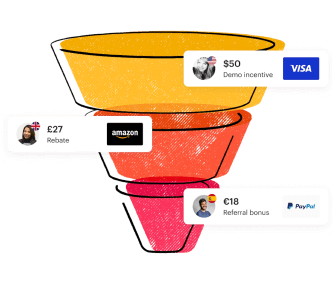
Most event incentives fall into three categories.
Gifts and vouchers
These work well for getting people in the door or encouraging them to engage at your booth or sessions. Offer a gift card to those who fill out a survey or sign up for a demo, or give every attendee a lunch voucher just for showing up.
Gift cards are the most widely used option. They work across borders, and recipients pick a brand they’ll use. The IRF's 2026 Industry Outlook found gift cards account for 30% of reward program allocations in North America and 34% in Europe. They've also overtaken merchandise as the most common event gift, and they're now part of more than 80% of North American event gifting programs.
Gifts and vouchers can be physical or digital, and you don't need to spend much to get attendees' attention. Even $10-$25 for coffee or lunch can be enough. If you use Tremendous to send it, recipients choose how they want to redeem their reward, so it's useful just about anywhere, even if there's no Starbucks nearby.
Games, contests, and lotteries
These encourage engagement at your booth and throughout the conference floor. A trivia question about your product or industry with a $10 prize gives people a reason to stop and interact. A raffle entry for anyone who books a demo generates steady booth traffic all day. This kind of structure lets your team get creative while generating foot traffic, qualified conversations, and demo sign-ups.
Access and discounts
Special pricing or access to exclusive content can make guests feel like they're getting something unique and limited, and it won't break the bank for you.
A good incentive strategy stacks multiple types. For example, you might offer a gift card for booking a demo at the event, then follow up with an exclusive referral reward afterward.
Are event incentives actually effective?
Three behavioral principles explain why incentives work:
Reciprocity
Reciprocity makes upfront incentives especially powerful. When you give something before asking for anything in return, recipients feel a natural pull to respond.
A 2021 study by Bretschi, Schaurer, and Dillman found that prepaid incentives are better at influencing behavior than promised incentives. They establish trust and trigger a hard-wired social instinct to reciprocate.
That's why a gift card sent ahead of an event can generate higher registration rates than the same gift card promised after attendance.
Positive reinforcement
This principle shapes behavior during your event. Operant conditioning (B.F. Skinner's framework for how rewards shape behavior) holds that actions followed by a positive outcome are more likely to be repeated.
When attendees are rewarded for specific actions (stopping by your booth, answering a question, booking time with your team), they're more likely to repeat those actions and stay engaged.
Urgency
Urgency inspires early commitments. Marketing researchers call this the mere urgency effect: People tend to act on time-sensitive offers even when the underlying task isn't a priority. Time-limited incentives, like early-bird discounts and registration bonuses with deadlines, push decision-making forward and turn fence-sitters into confirmed attendees.
You’ll see each principle at work in the sections below.
Event incentives by audience: What works for each group
If you're hosting your own event, your audience extends beyond attendees. Speakers, exhibitors, and sponsors each respond to different motivators.
Attendees
Attendees are the broadest audience, and they respond well to incentives tied to concrete actions.
A registration gift card delivered before the event triggers reciprocity and reduces no-shows.
A small booth-visit incentive gives attendees a reason to stop and engage.
A post-event survey incentive recovers lead-qualification data while the experience is still fresh.
Keep registration and booth incentives small so you can reserve more budget for bigger asks, like demo bookings.
Speakers
Speakers tend to value visibility and professional access more than monetary rewards. VIP experiences (exclusive briefings, analyst access, invitation-only dinners, or key introductions) often motivate them more than a gift card of equivalent face value. Senior practitioners and executives usually speak at conferences to build their reputation and their business, so early access and networking perks can carry more weight than a reward.
Exhibitors and sponsors
Exhibitors commit months in advance based on expected ROI, so provide incentives that reduce risk or increase their expected return. Early-bird pricing, premium booth placement, and sponsored speaking slots help them stretch their budget. And co-marketing incentives (joint promotion, shared lead list from a session, or post-event data report) can make participation feel less like a cost center and more like a channel.
How do pre-conference incentives boost registrations?
The goal of pre-conference incentives is to increase registrations, reduce no-shows, and get the right people in the room. Reciprocity is the mechanism: give first, and your prospects are more likely to commit.
Registration incentives are the most common application. Offer a gift card, prepaid card, or digital reward to anyone who registers by a specific date. The incentive doesn't need to be large, but it needs to be delivered before the event, not promised afterward.
VIP access incentives work well when you want to attract senior decision-makers. Exclusive briefings, analyst access, or invitation-only dinners before the event fully kicks off create scarcity without requiring a large per-head budget. The perceived value often exceeds the actual cost.
A few tips:
Deliver the incentive before the event, not as a post-attendance promise.
Set a registration deadline to create urgency around the offer.
Match the reward value to the ask. A $25 gift card for early registration fits, but a $100 card for a quick booth visit doesn't.
How do on-site incentives generate pipeline during a conference?
Once attendees are at your event, incentives shift from driving attendance to driving specific behaviors. Think booth visits, demo bookings, product interactions, and data capture.
The most directly measurable on-site incentive ties a reward to a qualifying action (like booking a demo or scanning a badge) rather than handing it to anyone who walks by.
Positive reinforcement is the underlying mechanism here. When a specific action (scanning a badge, booking a demo, or answering a question) leads to an immediate reward, attendees are more likely to repeat that action and more likely to remember your brand favorably.
Booth incentives are the most direct application: A prize like a gift card, a raffle entry, or a digital reward sent on the spot gives people a concrete reason to stop and engage with your team. Requiring a badge scan or a short conversation keeps your leads qualified and your booth staff focused.
Demo incentives are one of the highest-value applications at a conference. Offer a $50–$75 digital gift card to any qualified prospect who sits through a 15-minute demo. You're buying time with someone who would otherwise walk past your booth.
The math often works in your favor. When Tremendous tested gift card incentives for demo bookings on LinkedIn, response rates more than doubled and cost per lead dropped by 81%. The same principle applies on the conference floor: incentives turn passive foot traffic into active conversations.
Contests and raffles work when you want steady booth traffic throughout the day rather than a single conversion moment. Run a drawing every two hours, and require a badge scan or business card to enter. This gives prospects a reason to return after their first visit and keeps your team's pipeline conversations going all day.
How do post-conference incentives accelerate conversions?
Event teams know that post-conference follow-up is where tons of B2B event ROI is realized or lost. 92% of event teams planned to improve post-event attendee follow-up in 2024, and 77% planned to engage attendees year-round.
The problem is that by day three after a conference, your prospects have returned to their normal workload and your follow-up email is competing with dozens of others from other exhibitors. Incentives differentiate you during that window.
Post-event survey incentives are a simple way to recover data and pipeline signal. Offer a digital gift card to any attendee who completes a five-question feedback survey. You get structured lead-qualification data, and they get a reward for three minutes of their time.
77% of B2B buyers are more likely to engage when offered personalized experiences. A survey is one of the fastest ways to get the data you need to personalize the follow-up.
Demo-conversion incentives accelerate the deals that started at the event. If a prospect visited your booth but didn't book a full demo, a targeted follow-up can change that. "Thanks for stopping by. Here's a gift card. We'd love 20 minutes to show you [specific feature]."
Referral incentives extend your event's reach beyond the attendee list. Offer a digital reward to attendees who refer a colleague or customer who books a demo or attends a future event. This works especially well for community-driven companies or products with strong word-of-mouth.
How much should you spend on event incentives?
Setting an incentive budget can be challenging, especially as costs climb. In the Northstar/Cvent Meetings Industry PULSE Survey, 72% of planners said events are more valuable than before the pandemic, but 63% are looking for savings that won't hurt the attendee experience. If you don't hit the sweet spot with incentive amounts, they can quickly stretch your event budget past its limits.
According to the IRF's 2025 Trends Report, the average per-person gift card spend was $142 in 2024, and $50 and $100 gift cards accounted for half of all distributions. Event gifting budgets are tightening, though: The IRF's 2026 outlook found average per-person event gifting spend in North America fell from $649 to $397.
The right amount depends on what attendees do to earn it. The bigger the ask, the larger the incentive should be.
| Use case | Suggested range | Tips |
|---|---|---|
| Registration incentive | $25-$50 | Deliver before the event to trigger reciprocity and boost attendance |
| Travel/logistics subsidy | $25-$100 | Scale to distance, and consider ride-share credits |
| Booth visit or badge scan | $10-$25 | Tie to a qualifying action, not passive presence |
| Demo booking (at event) | $50-$75 | Focus on high-value leads, where cost-per-meeting math tends to favor you |
| Post-event survey | $15-$30 | Keep the survey short, like a quick net promoter score (NPS) check |
| Demo conversion (follow-up) | $50-$75 | Compare cost per qualified meeting to non-event meeting costs to prove ROI |
| VIP or executive access | $100-$150+ | Lead with perks and exclusives, since perceived value matters as much as face value |
A few things to factor into your budget:
58% of event planners expect event costs to rise 5–14% in the coming year, so build in a buffer.
Digital delivery eliminates shipping costs and logistics overhead, which adds up at scale.
Set a per-event cap and track redemption rates so you can optimize the incentive mix over time.
The right spend is the amount that makes your cost-per-qualified-meeting or cost-per-pipeline-dollar competitive with your other demand-generation channels. If a $50 gift card converts a booth visit into a demo that closes at your average rate, the math is straightforward.
Case study: FUSION more than doubled sales with digital incentives
FUSION Performance Group, a full-service events company, uses Tremendous to automate digital incentives for event registrations and feedback surveys, tailoring rewards to each event's theme. Since making the switch, FUSION has seen sales more than double.
Read the full case study to see how they did it.
How to send event incentives at scale
When most people think of event giveaways, they think of swag. But cheap swag often gets thrown out, and what most attendees want is the freedom to choose their own reward.
Tremendous is a digital rewards platform that lets event teams send gift cards, prepaid cards, and other incentives to attendees in 200+ countries, and recipients choose how they want to redeem. With more than 2,300 reward options and real-time delivery, it's built for the scale and speed that event marketing demands.
You can brand each reward with your logo and colors so attendees remember where it came from. With Tremendous, rewards take minutes to personalize and send, and seconds to redeem.
Want to add incentives to your event marketing strategy? Talk to our sales team, or sign up now.